
Understanding SALT scores.
A primer for the $QTTB readout.

What follows was initially a subsection in my forthcoming QTTB 0.00%↑ write up. I realised, however, that this is probably best separated as a short stand-alone read. The number of trials in Alopecia Areata (AA) is actually quite limited, and the more recent ones all centre on the Severity of Alopecia Tool (SALT) scores.
I have a suspicion that few people actually understand the significance of this, and so this brief write up will make sure we’re all on the same page for $QTTB. The SALT is some ways similar to an EASI but the main binary outcome (SALT20) is crucially different to an EASI-75. It’s also worth explaining why for small trials, only the SALT delta matters.
Understanding SALT Scores
Brad has a full head of thick hair. If you take an electric trimmer and shave off all of Brad’s hair, you’ve stimulated a SALT score of 100, or 100% hair loss. If you were to shave off exactly one half of Brad’s scalp, you would have a SALT of 50. Of course, Brad does not have AA and his hair would regrow naturally - but the analogy stands.
Alopecia Areata is considered severe with a SALT > 50 and very severe with a SALT >95, the later signifying almost complete hair loss. These metrics are relevant because AA trials in general target this SALT >50 population.
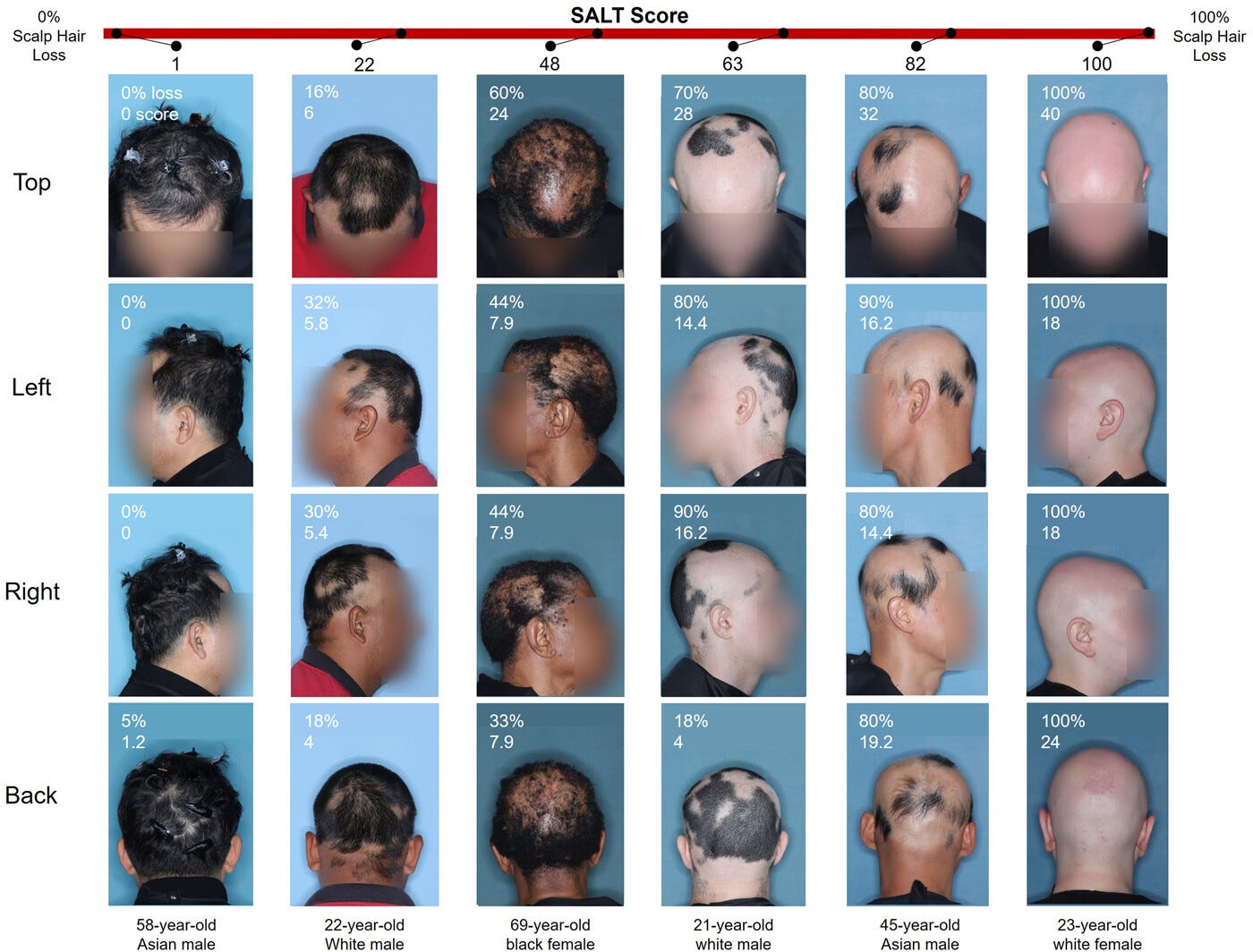
Trying to determine a SALT score with molecular precision is challenging, and it’s an inherently noisy metric subject to variability between even experienced assessors. So if you asked five people, even after extensive training, to score the cases in Figure 1, it’s doubtful you would get exact agreement though scores would likely cluster together. It’s therefore a mistake - in my opinion - to take SALT scores too literally in phase 2 studies; the trend and ballpark matter more. It’s also probably more informative to round salt scores down to the nearest 5, in my opinion!
Taking into account the limitations of the current generation of treatments, patients with severe (SALT > 50) or very severe alopecia (SALT > 95) who achieve hair regrowth to where there is less than 20% hair loss (SALT < 20) are considered to have had a cosmetically significant response, and for this reason this SALT20 is the US and EU regulatory outcome. An approximate example of a SALT20 can be seen in the second column of Figure 1 (SALT22); while not exactly great - if you consider the starting point as one of the last three columns (SALT 63/82/100) you can see this would represent substantial hair regrowth. An even better outcome would be a SALT10 meaning hair regrowth to where there is less than 10% hair loss (final SALT < 10). At a SALT10, hair loss is barely perceptible and as the efficacy of drugs improve, SALT10 will become the ultimate therapeutic aim in AA.
It’s important to clarify that SALT20/SALT10 refer to absolute scores. They are not analogous to PASI-75/90 or EASI-75 endpoints which define relative improvement (percentage reduction). The SALT is sometimes used in this relative way with the number underscored; so a SALT50 means a 50% improvement in SALT. However, as the AA field is still developing, there is a lot of inconsistency in how SALT endpoints are used, referenced and printed. When looking at SALT outcomes it’s critical to ensure which metric is actually intended , sometimes a SALT20 is actually referring to a SALT20!
While SALT20/SALT10 are the regulatory endpoints, these are not ideal for small exploratory phase 2 studies and the key metric to look at in small studies (N < 50) is the raw change in mean SALT scores (SALT delta). If you’re good with numbers this is intuitively obvious, but for many the reasons need to be articulated:
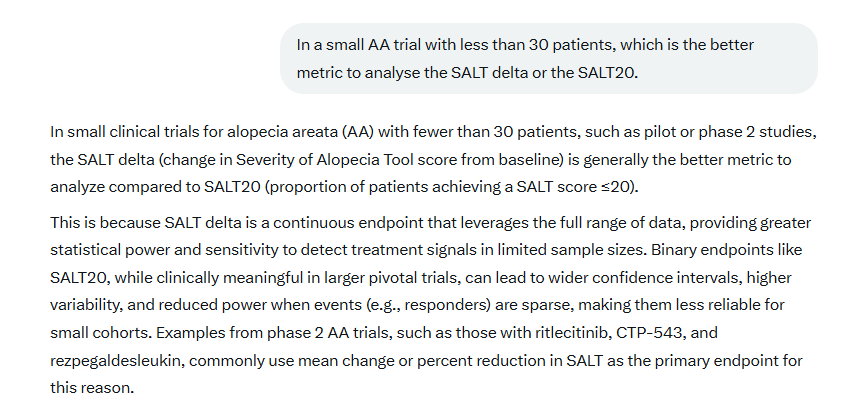
Therefore the discussion around efficacy of new experimental drugs at phase 2 will always centre on analysis of SALT delta, not SALT20.